

Don’t Forget About Flavor: How Excipient Source Impacts Taste
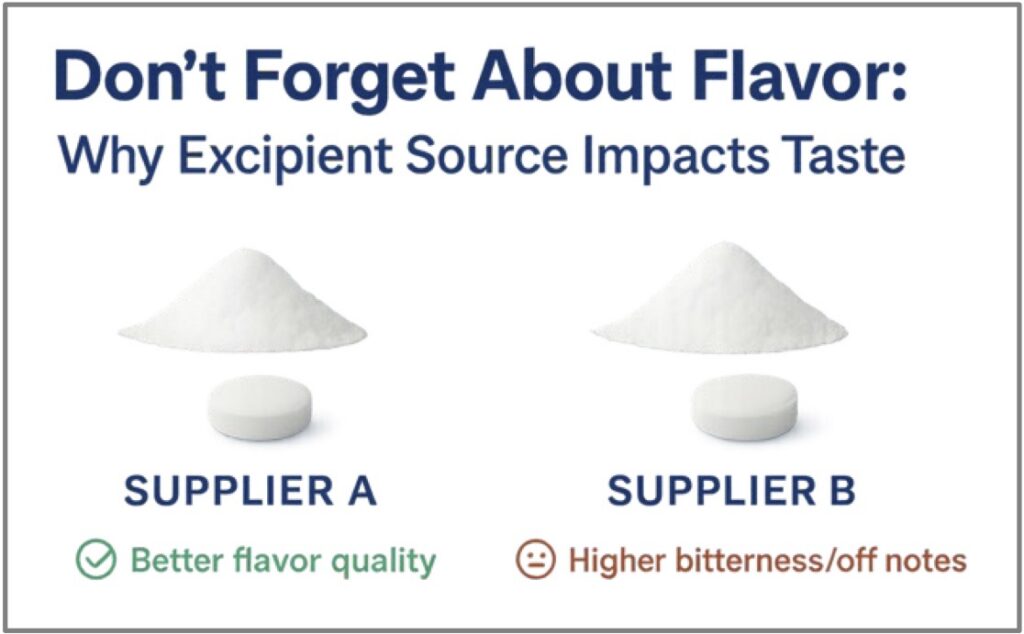
Don’t Forget About Flavor: How Excipient Source Impacts Taste
-David Tisi, Senopsys LLC
The principle of dual sourcing excipients is well established in pharmaceutical development, and its importance was recently discussed by Philippe Tschopp at PharmaExcipients. Formulation scientists routinely evaluate multiple suppliers for each excipient to reduce risk and maintain commercial flexibility throughout a product’s lifecycle.
However, one critical dimension is often overlooked in sourcing decisions: the sensory performance of excipients, i.e. flavor quality.
Subtle differences in impurity profiles, particle characteristics, or processing methods between suppliers can translate into meaningful differences in taste perception. These variations may not be captured in traditional pharmacopeial specifications (USP, NF, BP, and Ph. Eur.) yet they can significantly impact patient experience, adherence, and ultimately, product success.
This raises an important question for formulation scientists: If we already dual-source for quality, supply, and cost—why are we not systematically dual-sourcing for flavor.
These are not just hypothetical considerations. The example comparisons below show three excipient classes in which each alternative candidates meet the same NF monograph requirements yet delivered meaningfully different flavor performance. Together, these examples illustrate why supplier selection should include flavor, not just pharmacopeial compliance.
Examples:
Tocopherol Surfactant
Surfactants are among the most challenging excipient classes from a flavor perspective. In the comparison below, two tocopherol surfactants (Vitamin E TPGS) from different manufacturers show clearly different sensory profiles. The material from the first manufacturer (TPGS 1 in red) has a distinct “burnt-hair” aroma (odor), and more intense mouthfeel attributes such as burning and waxiness. By contrast, TPGS 2 has a cleaner profile, with lower bitterness and fewer negative mouthfeel attributes making it a better choice when the formulation goal is a taste-neutral drug product.
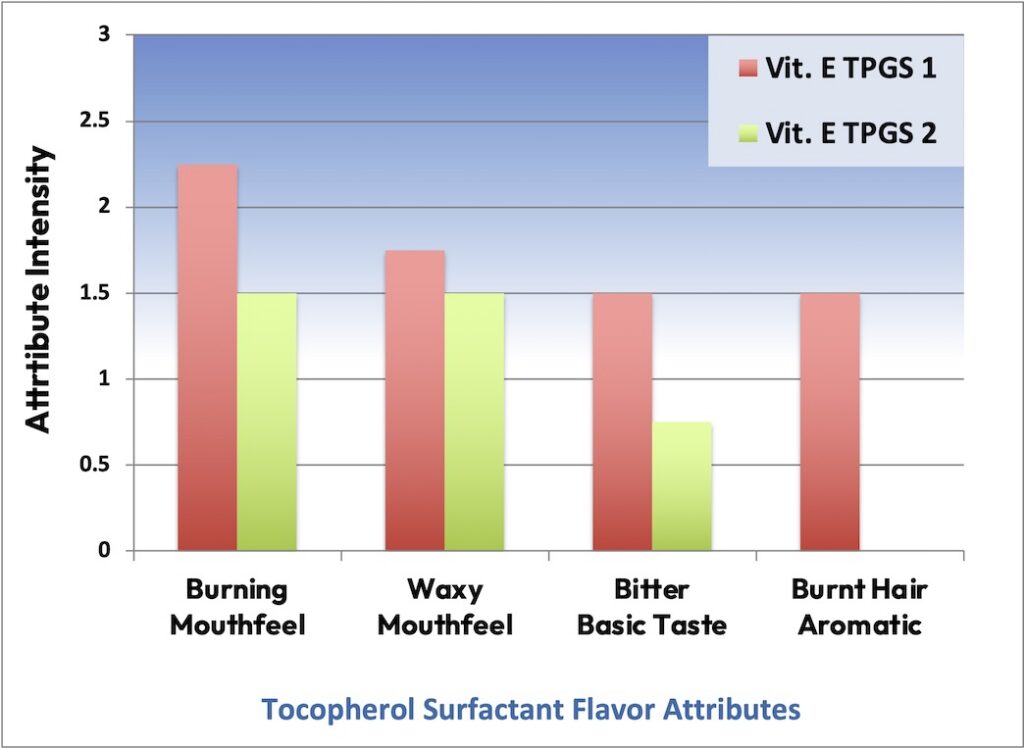
* Throughout this post, the flavor of samples were measured by Senopsys’ trained adult panels using the Flavor Profile Method of analytical sensory analysis.
Propylene Glycol
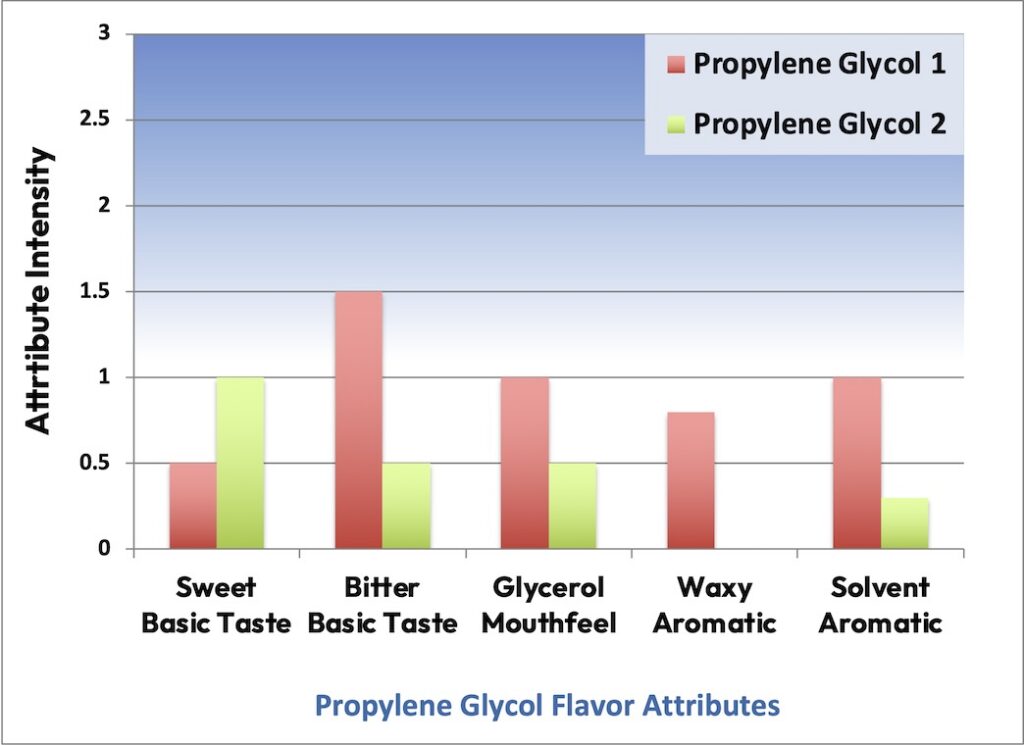
Solvents such as propylene glycol often make up a larger proportion of a formulation than surfactants but usually have a lower flavor impact. Even so, supplier differences can still matter. In the comparison below, propylene glycol sample is relatively clean (green), with aversive sensory attributes below the level of likely patient perceptibility. The red candidate is more bitter and has stronger negative aromatics. Although both options meet monograph specifications, Propylene Glycol #2 is clearly the superior candidate from a flavor quality standpoint.
PEG 40 Hydrogenated Castor Oil
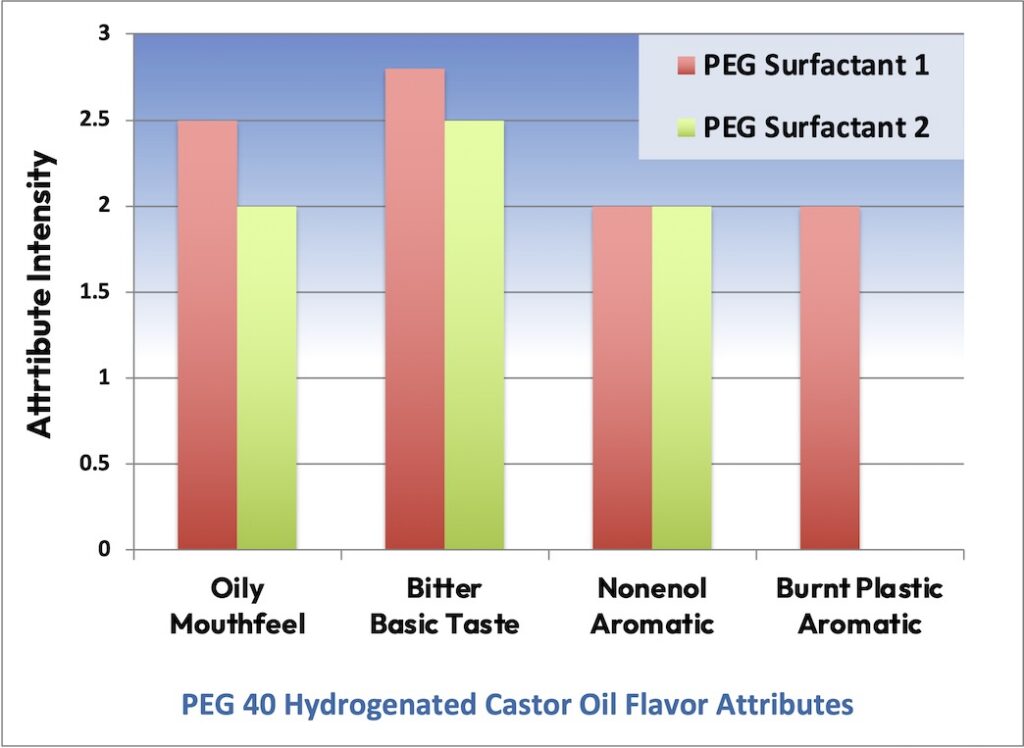
For some extremely challenging excipients, there may be no truly “good” option—only a less problematic one. The surfactant PEG 40 Hydrogenated Castor Oil is one such case, and the better long-term formulation decision may be to replace it with an alternative surfactant. If replacement is not feasible, supplier choice still matters. Although both materials below show moderate to strong intensity aversive sensory attributes, one sample (green) is somewhat cleaner because it lacks the burnt aromatic off-notes seen in the other.
Takeaway
Excipient sourcing is already a core part of formulation risk management, but these examples show that pharmacopeial compliance alone does not guarantee equivalent sensory performance. Incorporating flavor assessment into supplier evaluation can help formulation scientists make better choices for patient experience, adherence, and product success.
Do You Have A Taste Masking Challenge?
Are you faced with the need to develop a palatable drug product to support clinical trials or commercial development? Our scientists are expert in both taste assessment and taste masking.
We use our experienced GCP-compliant taste panels and analytic tools to quantify the taste masking challenge and guide formulation development. And we apply a structured, sensory-directed development approach pioneered in the food industry to create palatable, taste-masked drug formulations for liquids, powders and solids.
Talk to our team about your specific formulation challenge.
Palatability should never be the reason a medicine fails.
About the Author
David Tisi, Technical Director at Senopsys, is an expert in sensory-directed pharmaceutical development. He applies GCP-compliant human taste assessment, analytical tools, and formulation strategies to quantify and address complex palatability challenges across dosage forms and development stages.