

Why Palatability Matters
Palatability should never be the reason a medicine fails.
Aversive taste, odor, or mouthfeel can lead to dose refusal, poor adherence, and ultimately compromised clinical and commercial outcomes. While this challenge is well recognized in pediatric populations, it extends to many adults—particularly those with swallowing difficulties (dysphagia) or those requiring alternative oral dosage forms.
For drug developers, the challenge is compounded in early-stage development, where the sensory properties of new chemical entities (NCEs) are often unknown.
What is Flavor?
The flavor of drugs can be understood across three key dimensions: Modality, Intensity, and Duration
1. Modality
Modality is the sensory perception pathway that a drug substance acts on. Effective taste masking begins with understanding the specific modality contributing to aversion. Aversive flavor attributes present across 4 modalities – basic tastes, aroma, mouthfeel and texture:
Taste
Basic tastes perceived by taste receptors on the tongue
Aroma
Aromas are perceived through olfaction and can strongly influence patient acceptance.
Mouthfeel
Some APIs directly stimulate trigeminal nerve receptors.
Texture
Mechanical and physical characteristics of a dosage form also contribute to palatability.
Flavor Modality Examples:
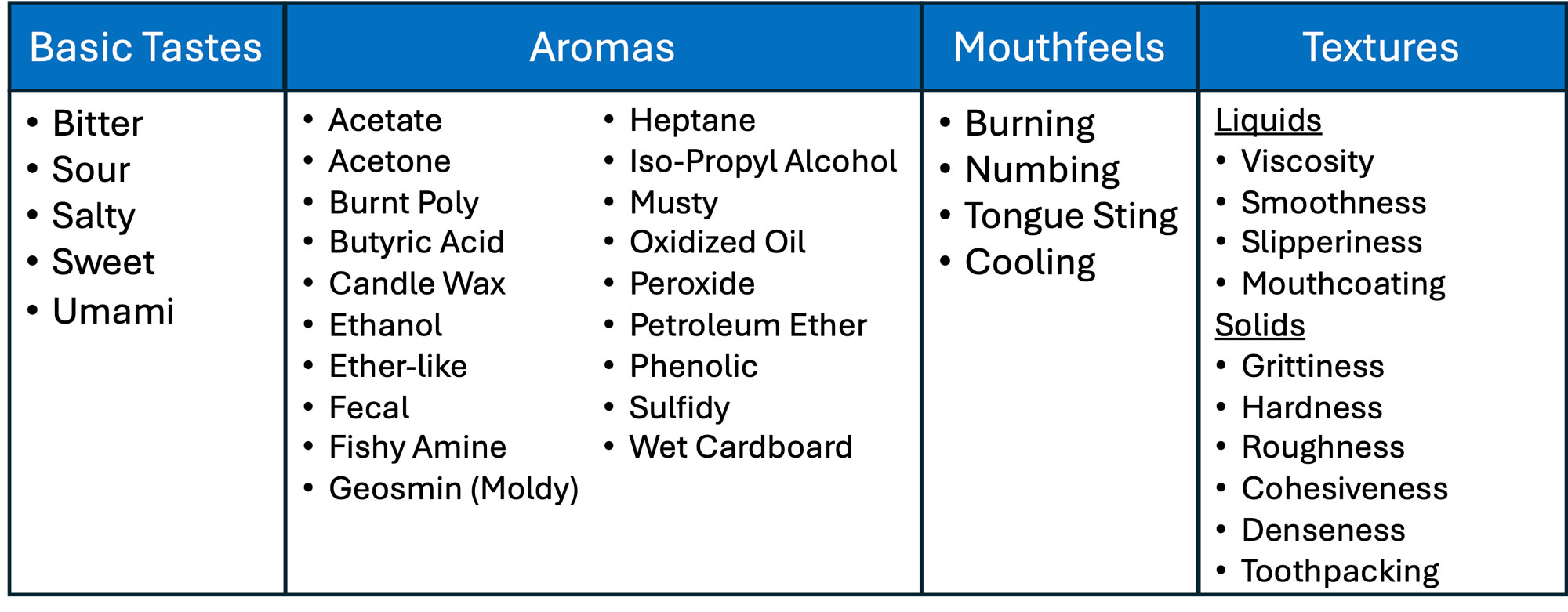
In 2024, Senopsys published the taste masking challenge of 155 APIs. A spectrum of aversive attribute modalities were seen across these drugs. However, importantly, most APIs exhibit more than one aversive attribute, often requiring multiple strategies to address.
2. Intensity
The strength of a sensory attribute is the primary determinant of acceptability.
Mild bitterness or slight irritation may be tolerated—but as intensity increases, these attributes rapidly become unacceptable to patients.
3. Duration
Drug-related sensory attributes often linger far longer than those in foods or beverages. While the bitterness of coffee or dark chocolate fades quickly, the aftertaste of many APIs can persist for 30 minutes or longer—significantly increasing the difficulty of taste masking.
How Humans Perceive Flavor
Psychophysics is the scientific study of the relation between stimulus and perception. Nearly all stimuli (taste, smell, sound, sight) follow a similar response profile, idealized as shown.
At low and high strengths, perceived changes in stimulus intensity become asymptotic to the changes in strength. Thus, the linear portion of the stimulus response curve defines the human sensory world.
To this response curve, three important cognitive functions can be ascribed:
- Detection threshold: the point at which a difference is perceived, but not identified
- Recognition threshold: the point at which a sensory quality (e.g., bitter, sweet) can be identified
- Saturation: the point beyond which increases in stimulus produce little or no additional perceived intensity
The linear region between detection and saturation defines the range in which changes in stimulus meaningfully affect perception—and where taste masking strategies must operate.
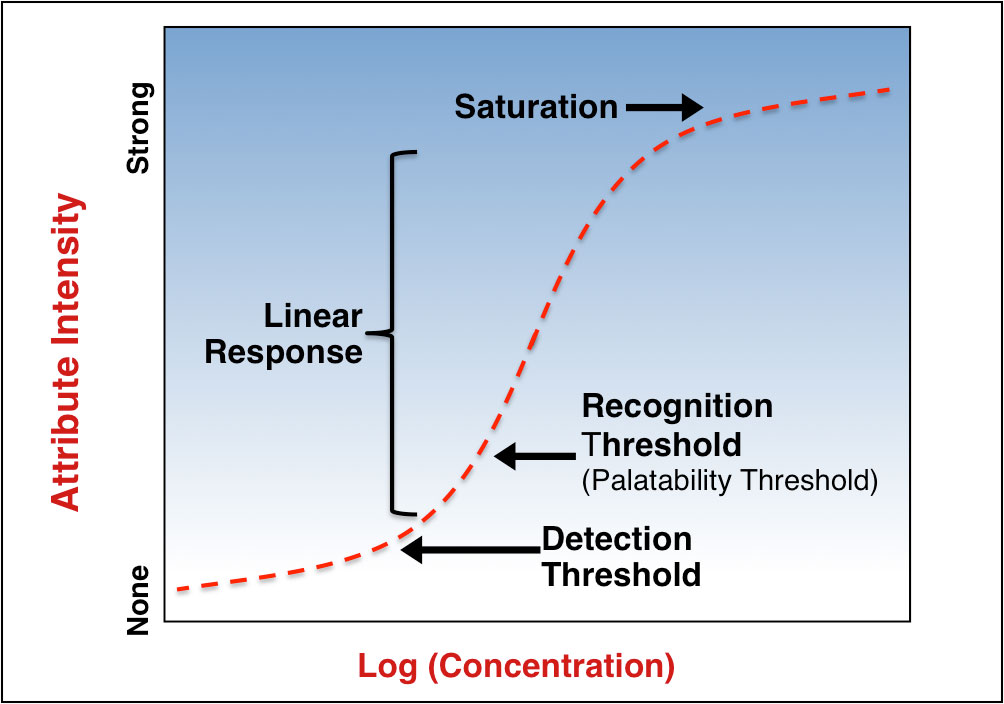
The recognition threshold is the most important in developing palatable pediatric drug formulations – aversive sensory attributes below this intensity will not be perceptible to patients.
How Flavor Is Measured
Human sensory perception is the only clinically relevant model for drug palatability.
Senopsys conducts sensory analysis using trained human panels under GCP-compliant conditions, applying the internationally recognized Flavor Profile Method.
This approach:
- Identifies all relevant sensory attributes (taste, aroma, mouthfeel, texture)
- Quantifies their intensity using calibrated reference standards
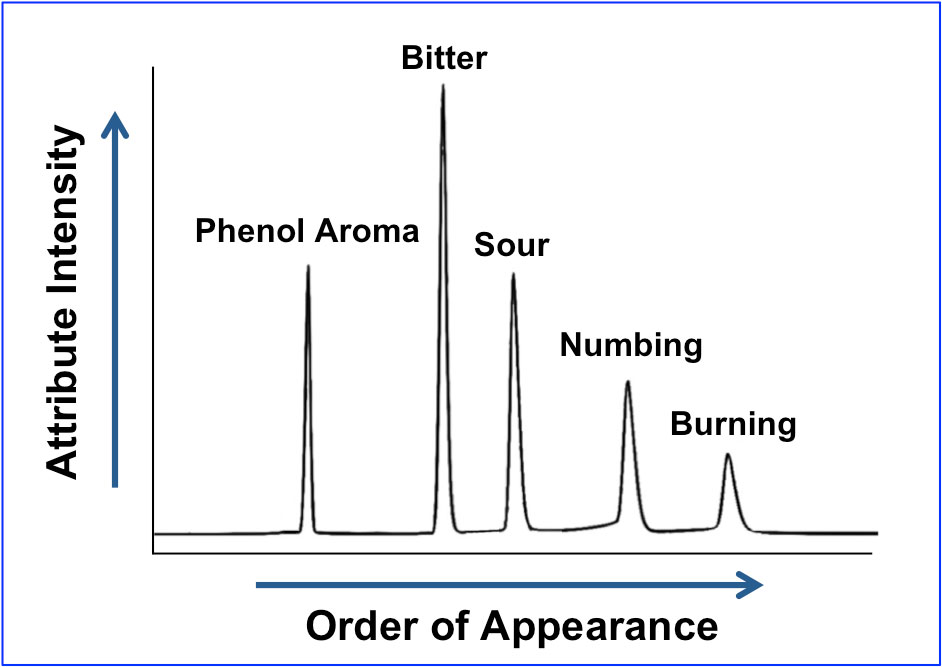
- Generates a detailed sensory “fingerprint” of a formulation
The resulting profile is analogous to a chromatogram, where:
- Each peak represents a specific sensory attribute
- Peak height reflects perceived intensity
This enables precise diagnosis of the taste masking challenge and objective evaluation of formulation performance.
What Is a “Palatable” Drug Product?
Definitions of palatability are often subjective, varying across dictionaries, expert opinions, and regulatory guidance.
Senopsys applies a science-based definition grounded in perception:
“Palatable drug products are those in which aversive sensory attributes are below the recognition threshold.”
This definition is important because it establishes:
- An objective standard
- A measurable endpoint
- A clear target for formulation development
Why Proper Diagnosis Is Critical
Taste masking is not a single problem—and it does not have a single solution.
Taste, smell, and irritation are mediated by different biological pathways, and each requires a distinct technical approach. Misidentifying the root cause of aversiveness can lead to ineffective or inefficient formulation strategies.
Successful development of palatable drug products therefore depends on:
- Accurate identification of all relevant sensory attributes
- Quantification of their intensity and duration
- Selection of strategies aligned with the underlying sensory mechanisms
These form the foundation for developing drug products that patients can and will take—consistently and as intended.
Explore how Senopsys applies these principles through its Taste Assessment and Taste Masking capabilities.