Posted by Senopsys on April 9, 2026
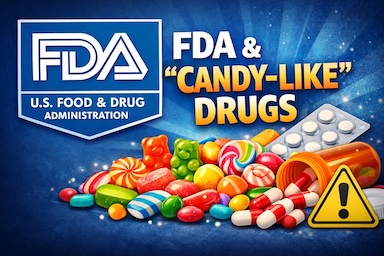
The increasing use of flavored, chewable, and rapidly dissolving dosage forms has transformed the patient experience of taking medicines—particularly for pediatric and geriatric populations. At the same time, these innovations have raised an important regulatory question: When does a medicine become “too much like candy”?
Read More
Posted by Senopsys on January 13, 2024

A neighbor slipped and fell in his driveway. He was unable to get up and was taken to the hospital by ambulance. Before medical treatment could be initiated, the hospital needed to run diagnostic tests, e.g., x-ray, MRI. The same is true for developing palatable formulations – it’s not enough to know that it tastes “yucky” as there’s no universal “yummy” excipient.
Read More
Posted by Senopsys on May 28, 2022

It is widely recognized that young children cannot swallow traditional tablets, but difficulty in swallowing tablets (dysphagia) is not limited to children. An estimated 40% of adults report difficulty in swallowing tablets, which is increasingly common among older patients. How can the formulation scientist address these important patient needs, and how can “swallowability” even be quantitatively measured?
Read More
Posted by Senopsys on May 5, 2019

An estimated 80% of new drug actives are classified as poorly soluble. There are a number of approaches for enhancing solubility – alternative salt forms, particle size reduction and solubility-enhancing excipients, among others. Like APIs, many excipients are known to be bitter or have other aversive sensory attributes including aromatic off-notes (malodor) and trigeminal irritation (e.g., tongue sting and mouth or throat burn). In some cases, the taste masking challenge of the excipient system can be greater than for the API itself.
Read More
Posted by Senopsys on February 4, 2019

Listerine® PocketPaks® – the postage stamp-size strips that melt in your mouth – became an instant hit after their market debut with more than 100 million units sold. Named a “Best Innovation” by Time Magazine, audiences and critics raved about their portability and ability to take without water. Not only did Listerine PocketPaks create a popular sensation, they established a new genre for oral drug delivery!
Read More
Posted by Senopsys on August 29, 2018
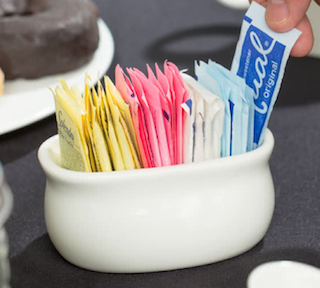
Try this experiment next time you are in a coffee shop: Open a packet of artificial sweetener (pink, yellow, or blue) and pour it directly on your tongue. Yuck! That tasted nothing like a spoonful of sugar – so what happened? Though artificial sweeteners are widely used in pharmaceuticals, formulating with them is far from straightforward.
Read More
Posted by Senopsys on May 11, 2018

Regulations in the EU and US require the development of pediatric dosage forms of every new drug. Pediatric Investigation Plans (for EMA) and Pediatric Study Plans (for FDA) should be submitted early in development, but frequently are filed late and lack specificity. A savvy applicant should take a proactive approach by proposing scientific, stage-gate study plans to fulfill regulatory requirements while mitigating technical and economic risks.
Read More
Posted by Senopsys on January 9, 2018

If you’re a Disney fan of a certain age, you probably can sing the lyrics to Mary Poppins Spoonful of Sugar Makes the Medicine Go Down. Many APIs are known to be bitter, some extremely so. The addition of flavor – orange, grape, berry, chocolate – cannot reduce bitterness as taste and smell have different perception pathways. Rather bitterness is reduced by blending with the complementary basic tastes – sweet, sour and salty – through the mechanism of taste/taste interaction. When properly blended, the result is a neutral tasting (“white”) base in which the basic tastes are not separately perceived.
Read More
Posted by Senopsys on November 6, 2017

Captain’s Log, Star Date 11.6.17: Mini-tablets are taking over the market for pediatric medicines.
Many believe that all good things come in small packages – and pediatric medicines should be no exception. However, while mini-tabs are de rigueur, they may not represent the silver bullet solution they are purported to be.
Read More
Posted by Senopsys on September 8, 2017

To a sensory scientist “flavor” refers to all tastes, aromas, mouthfeels and textures of a product. To a formulator, a flavor is a commercial ingredient that is a blend of volatile chemicals responsible for imparting the aroma of a product. In this post, we’ll focus on the formulator’s view, describing how these commercial “flavors” are created.
Read More