Don’t Forget About Flavor: How Excipient Source Impacts Taste
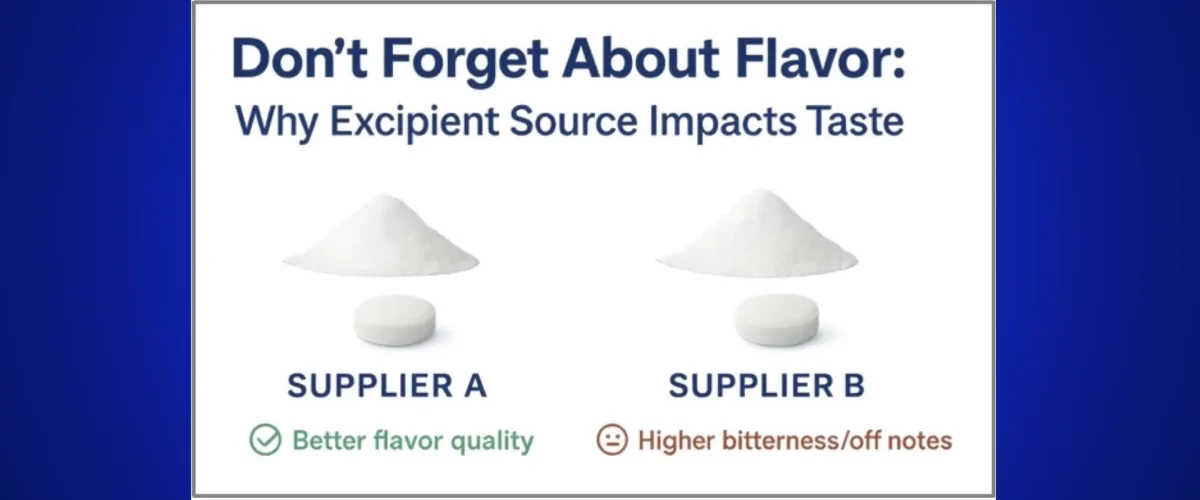
A question for formulation scientists: If we already dual-source for quality, supply, and cost—why are we not systematically dual-sourcing for flavor quality?


Explore expert perspectives, scientific advances, and practical strategies to help develop medicines that patients are willing to take.
Do you have an idea for a future topic? We’d like to hear from you at feedback@senopsys.com.
A question for formulation scientists: If we already dual-source for quality, supply, and cost—why are we not systematically dual-sourcing for flavor quality?

An estimated 80% of new drug actives are classified as poorly soluble. There are a number of approaches for enhancing solubility – alternative salt forms, particle size reduction and solubility-enhancing excipients, among others. Like APIs, many excipients are known to be bitter or have other aversive sensory attributes including aromatic off-notes (malodor) and trigeminal irritation (e.g., tongue sting and mouth or throat burn). In some cases, the taste masking challenge of the excipient system can be greater than for the API itself.
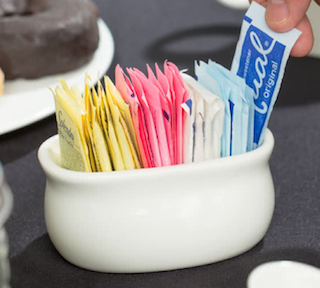
Try this experiment next time you are in a coffee shop: Open a packet of artificial sweetener (pink, yellow, or blue) and pour it directly on your tongue. Yuck! That tasted nothing like a spoonful of sugar – so what happened? Though artificial sweeteners are widely used in pharmaceuticals, formulating with them is far from straightforward.

If you’re a Disney fan of a certain age, you probably can sing the lyrics to Mary Poppins Spoonful of Sugar Makes the Medicine Go Down. Many APIs are known to be bitter, some extremely so. The addition of flavor – orange, grape, berry, chocolate – cannot reduce bitterness as taste and smell have different perception pathways. Rather bitterness is reduced by blending with the complementary basic tastes – sweet, sour and salty – through the mechanism of taste/taste interaction. When properly blended, the result is a neutral tasting (“white”) base in which the basic tastes are not separately perceived.

To a sensory scientist “flavor” refers to all tastes, aromas, mouthfeels and textures of a product. To a formulator, a flavor is a commercial ingredient that is a blend of volatile chemicals responsible for imparting the aroma of a product. In this post, we’ll focus on the formulator’s view, describing how these commercial “flavors” are created.

By FDA regulation, flavor excipients are divided into four categories. What are the practical differences between these categories and which are appropriate for pharmaceutical formulations? In our latest post, we hope to answer these questions.

By: David Tisi – Senopsys Technical Director “Flavor”, “Taste”, and “Smell” are not the same. To a sensory scientist, the term “flavor” refers to the combination of taste, aroma, mouthfeel and texture. This definition is important as we debunk one of the great myths of taste masking: that taste and smell are the same.

By: David Tisi – Senopsys Technical Director Many Active Pharmaceutical Ingredients (APIs) are bitter, some extremely so. Often a formulator’s first reaction to taste masking is to add a “flavor” to the formulation to mask the bitterness. This approach to taste making is not usually successful because of differences in the physiology of taste and

By: David Tisi – Senopsys Technical Director What is Flavor? We can trace the origins of many dosage forms and pharmaceutical technologies back to the food industry – and today we consider it a rich source for approaches, tools and methods that pharmaceutical scientists can adapt to develop palatable drug products. How do we define