

From Food to Pharma: How Human Taste Became a Scientific Instrument
From Food to Pharma: How Human Taste Became a Scientific Instrument
-Jeff Worthington, Senopsys LLC
Why Senopsys Approaches Drug Palatability Differently
When scientists characterize a new drug substance, they routinely measure its purity, potency, stability, and dissolution profile using sophisticated analytical instruments. Yet one critical property cannot be measured instrumentally: the patient’s sensory experience.
Taste, aroma, mouthfeel, texture, and aftertaste remain uniquely human—and uniquely measurable through validated sensory science methodologies developed over decades
From Subjective Opinion to Quantitative Science
It was not always this way.
Before the mid-twentieth century, food tasting was largely based on opinion. One individual might describe a product as ‘pleasant,’ another as ‘too bitter,’ with little consistency or reproducibility.
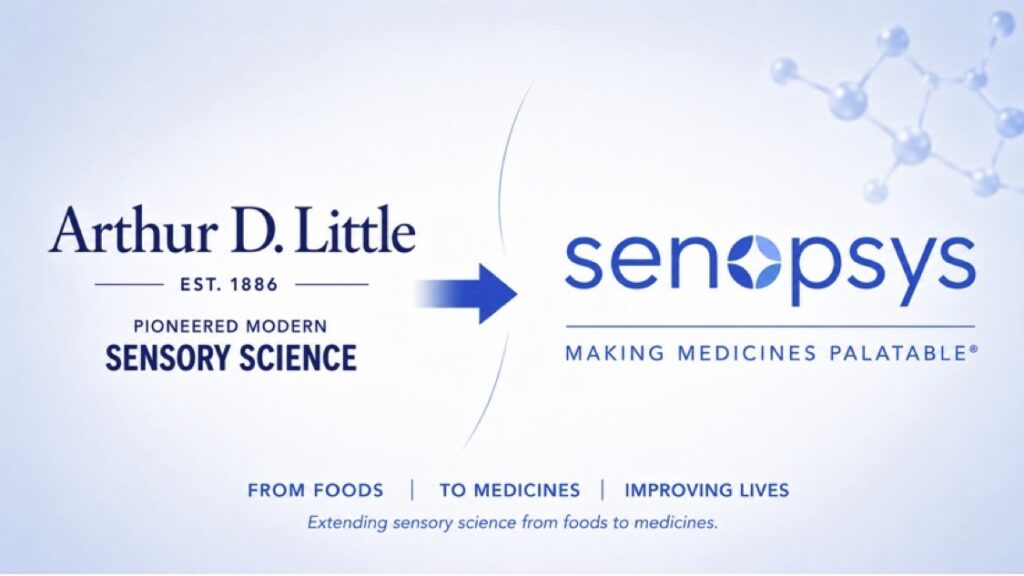
That changed with the emergence of modern sensory science. Among the organizations leading this transformation was Arthur D. Little, whose scientists helped pioneer methods that enabled trained human assessors to objectively characterize flavor rather than simply express preference.
One of the most influential advances was the Flavor Profile Method, developed by Arthur D. Little sensory scientists in the 1940s. It became one of the foundational analytical sensory methodologies adopted throughout the food industry. Rather than asking whether someone liked a product, trained panels identified individual taste, aroma, mouthfeel, texture, and aftertaste characteristics, measured their intensity, and documented how those perceptions changed over time.
For the first time, human sensory perception could be evaluated with the same scientific rigor applied to chemistry or engineering.
The food industry quickly adopted quantitative sensory analysis for product development, quality control, and competitive benchmarking. Those same scientific principles would eventually prove equally valuable for medicines, although pharmaceutical development was slower to embrace them.
Pharmaceutical Development Followed a Different Path
Unlike foods and beverages, medicines are not intended to taste good. Their primary purpose is therapeutic efficacy.
As a result, pharmaceutical development traditionally focused on safety, efficacy, manufacturing, and stability. Palatability was often addressed late in development by adding flavors or sweeteners after key formulation decisions had already been made. What was frequently missing was a rigorous understanding of the sensory characteristics of the drug itself.
I have long believed that understanding the sensory profile of an active pharmaceutical ingredient (API) should come before selecting a taste-masking strategy. Doing so enables formulation scientists to make more informed decisions about whether flavor systems, coating technologies, encapsulation, complexation, or other approaches are most likely to succeed. It also replaces opinion with measurable data.
Measuring More Than Bitterness
One common misconception is that taste masking simply means covering bitterness.
In reality, many APIs exhibit multiple aversive sensory attributes. In addition to bitterness, compounds may produce metallic notes, astringency, sourness, trigeminal irritation, lingering aftertastes, unpleasant aromas, or undesirable mouthfeel. These attributes often occur together, requiring different formulation strategies.
Quantitative sensory analysis identifies not only which attributes are present, but also their relative intensity and how they evolve during oral exposure. That information enables formulation scientists to select approaches tailored to each molecule rather than generic solutions.
The Human Sensor Still Matters
Electronic taste sensors and artificial intelligence continue to expand formulation scientists’ toolkit and will play an increasingly important role.
From my perspective, these technologies are valuable complements—but they are not substitutes for understanding what patients actually experience.
Only trained human sensory panels can simultaneously evaluate the complete sensory experience—integrating taste, aroma, mouthfeel, texture, aftertaste, and temporal changes into a clinically meaningful assessment of palatability. For this reason, validated human sensory methodologies remain an essential component of patient-centric pharmaceutical development.
Applying Decades of Sensory Science to Medicines
Electronic taste sensors and artificial intelligence continue to expand formulation scientists’ toolkit and will play an increasingly important role.
My career began at Arthur D. Little, where I had the opportunity to work alongside scientists applying the Flavor Profile Method to food product development. That experience convinced me that objective human sensory data could guide formulation decisions just as effectively in pharmaceuticals.
When I founded Senopsys in 2006, my goal was not to invent new sensory science, but to apply proven methodologies to one of pharmaceutical development’s most persistent challenges: making medicines patients are willing to take.
Over the past two decades, we’ve adapted the principles of the Flavor Profile Method specifically for pharmaceutical development. Using trained adult sensory panels operating under Good Clinical Practice (GCP), we objectively characterize the taste, aroma, mouthfeel, texture, and aftertaste of drug actives and formulations.
Those assessments have contributed to FlavorMetrics℠, one of the pharmaceutical industry’s largest proprietary databases of aversive sensory characteristics of investigational drug actives, providing insights into the palatability challenges of 160 investigational drugs—and counting.
I continue to believe that combining validated human sensory analysis with pharmaceutical formulation expertise gives scientists better data for developing taste-masking strategies tailored to the unique sensory profile of each API.
Looking Forward
As pharmaceutical development increasingly emphasizes patient-centric drug products, I believe the importance of quantitative sensory science will only continue to grow.
The same scientific principles pioneered at Arthur D. Little continue to help formulation scientists better understand the sensory challenges of APIs and develop drug products that patients are more willing to take.
Artificial intelligence will undoubtedly accelerate formulation development. But the ultimate measure of success remains unchanged: the patient’s experience.
That principle has guided my work throughout my career, and it continues to guide Senopsys today.
Palatability should never be the reason a medicine fails.
Do You Have A Taste Masking Challenge?
Are you faced with the need to develop a palatable drug product to support clinical trials or commercial development? Our scientists are expert in both taste assessment and taste masking.
We use our experienced GCP-compliant taste panels and analytic tools to quantify the taste masking challenge and guide formulation development. And we apply a structured, sensory-directed development approach pioneered in the food industry to create palatable, taste-masked drug formulations for liquids, powders and solids.
Talk to our team about your specific formulation challenge.
About the Author
Jeff Worthington is President and Founder of Senopsys, established in 2006 to advance the development of palatable, patient-accepted medicines. With over three decades of experience, he advances approaches to taste masking that help ensure palatability does not become a barrier to clinical or commercial success.