

Understand the Taste Masking Challenge Before Formulation Development Begins
Senopsys has built one of the pharmaceutical industry’s most extensive proprietary databases of aversive flavor attributes of investigational drug actives, generated using trained human sensory panels.
By understanding how an investigational drug compares to previously characterized compounds, developers can better assess palatability risk, guide dosage form selection, prioritize taste masking strategies, and reduce downstream development uncertainty.
What’s in the Database
The database contains qualitative and quantitative data for each investigational new drug (160 and counting):
- Qualitative data:
- Indication
- Target patient population
- Intended dosage form(s)
- Dose
- Quantitative data:
- Aversive flavor attributes
- Palatability thresholds
What We’ve Learned
1. Most investigational drugs have a complex flavor.
Analysis of the investigational drug active data reveals that:
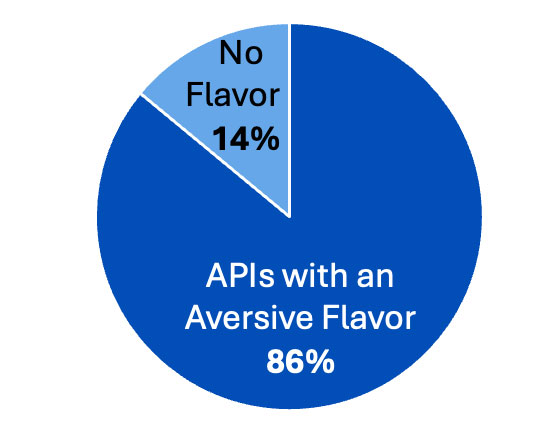
- 86% exhibit aversive flavor attributes
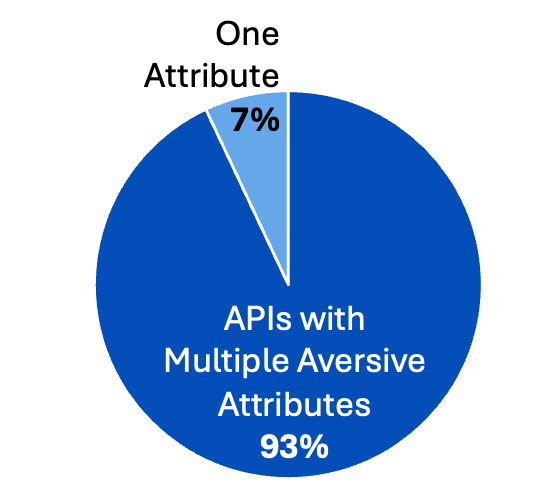
- 91% of those exhibit multiple aversive sensory attributes
2. Many investigational drugs represent a difficult taste making challenge
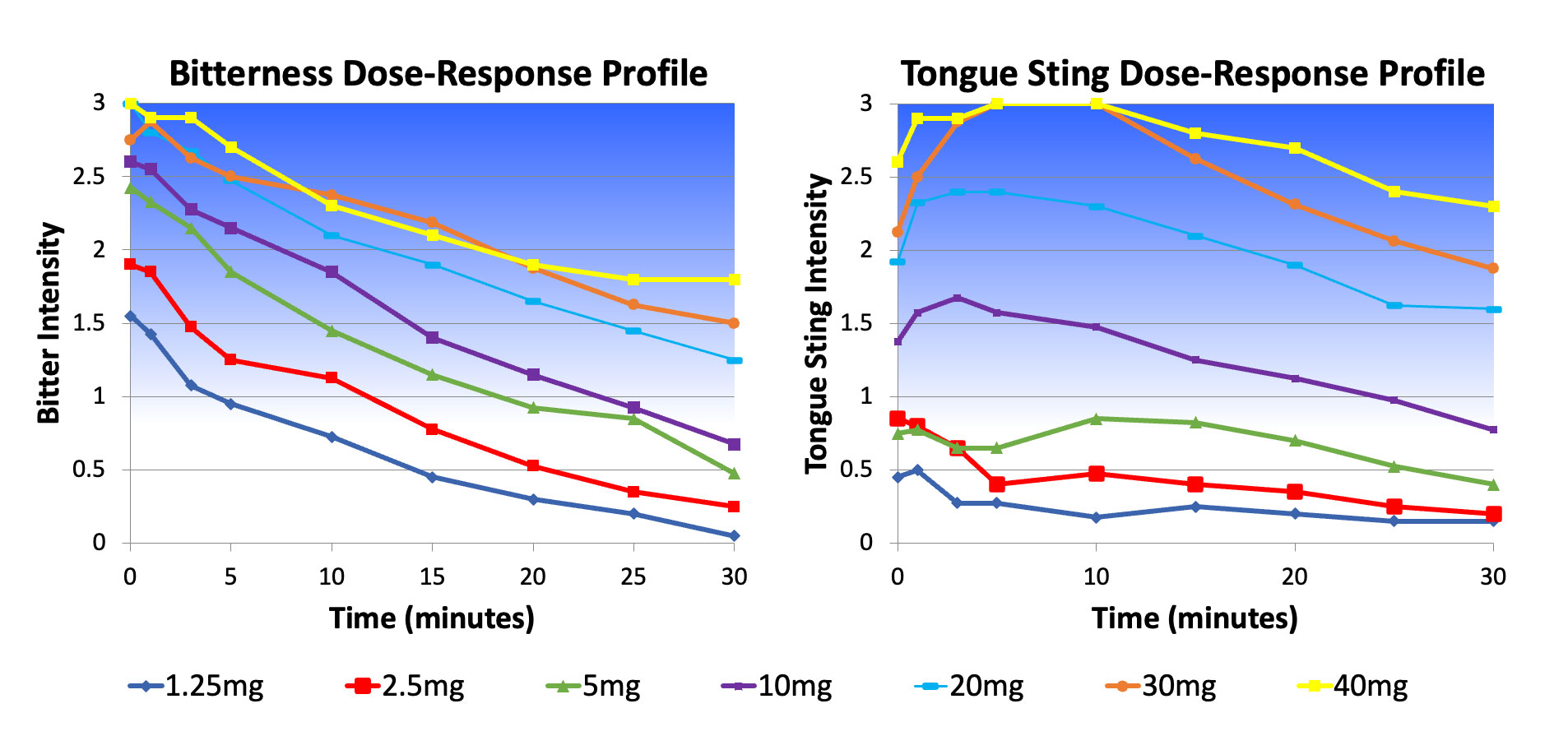
The database contains palatability thresholds that are determined through dose-response sensory analysis. Palatability thresholds can be used to guide dosage form and taste masking technology selection and optimization.
For many drugs formulation -based approaches are effective in developing palatable products. However, some drugs have palatability thresholds that are 2 or 3 orders of magnitude lower than the clinical dose. In these cases, a drug active “sequestration” technology will be required to develop (e.g., encapsulation, complexation, particle coating) for palatability.
These findings reinforce an important reality: taste masking challenges are often multidimensional and very difficult to solve.
Why This Matters
Many children – and a significant number of adults with dysphagia – cannot easily swallow tablets or capsules and require alternative dosage forms such as liquids, powders, granules, chewable or orally disintegrating tablets.
Regulatory agencies increasingly expect the development of age-appropriate, acceptable dosage forms as part of pediatric development programs:
- EMA – Paediatric Investigation Plan (PIP)
- FDA – Pediatric Study Plan (PSP)
An otherwise effective therapy can encounter significant development challenges if sensory attributes are misidentified or underestimated early in formulation development.
A Data-Driven Approach to Taste Masking
Senopsys’ aversive flavor attribute database enables comparison to other investigational compounds and helps answer critical early-stage questions:
- Which sensory attributes are most problematic – bitter, burning, malodor? Are there more than one that need to be addressed?
- Is this API mildly challenging or exceptionally difficult to mask?
- Is a conventional excipient approach likely to succeed?
- Will more advanced taste masking technologies ultimately be required?
- How aggressively should palatability risk be addressed during development?
This early insight can help avoid inappropriate technology selection, reduce reformulation risk, and improve development efficiency.
Do You Understand the Palatability Risk Profile of Your API?
Connect with us to assess your investigational drug’s taste masking challenge and identify the most effective formulation strategy.