

Five Takeaways from the University of Maryland CERSI Pediatric Conference
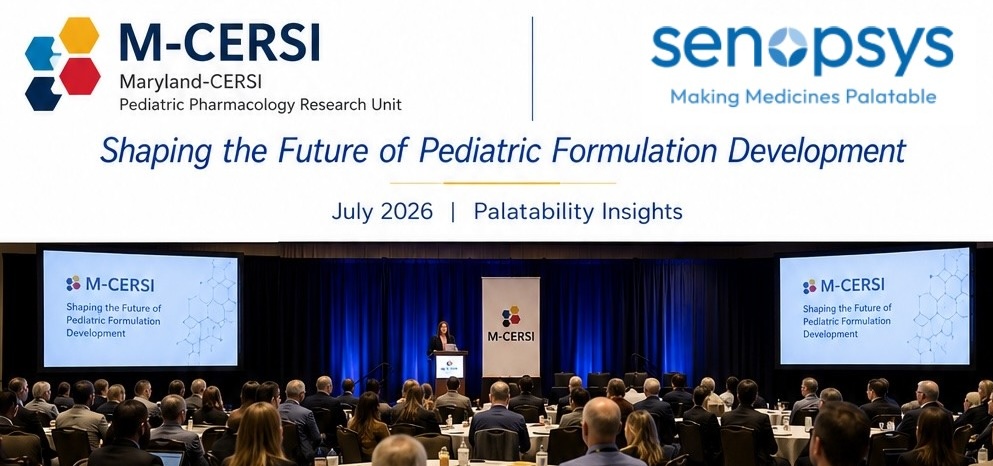
Beyond Taste Masking: Five Takeaways from the University of Maryland CERSI Pediatric Formulation Workshop
-Jeff Worthington, Senopsys LLC
The recent University of Maryland CERSI workshop, Shaping the Future of Pediatric Formulation Development, brought together regulators, industry, academia, and patient advocates to discuss the challenges of developing medicines for children.
Senopsys was proud to sponsor this year’s meeting and present a scientific poster describing the sensory characteristics of 160 investigational drugs drug substances assessed by Senopsys and captured in the FlavorMetrics™ Palatability Database.
While the conference covered a broad range of topics—from regulatory science to manufacturing and nomenclature—several themes emerged that reinforce where pediatric formulation development is heading and where palatability science can make the greatest impact.
1. The Patient Experience Begins Long Before Approval
Perhaps the most memorable presentations were delivered not by scientists, but by parent advocates from International Children’s Advisory Network (iCAN) caring for children with serious illnesses.
Their stories served as a reminder that regulatory approval is not the end of the journey. Even the most effective medicine provides little benefit if families struggle every day to administer it.
Patient-centric drug development extends well beyond efficacy and safety. Formulation attributes—including taste, smell, mouthfeel, dosing convenience, and ease of administration—remain critical determinants of real-world adherence.
2. Better Excipient Decisions Require Better Data
Multiple sessions focused on pediatric excipient selection, including FDA resources such as the Inactive Ingredient Database (IID), ELSA, and other evolving tools for evaluating excipient safety.
As these resources become more sophisticated—and increasingly supported by automation and artificial intelligence—the opportunity extends beyond safety. Formulators also need better information on how excipients influence the sensory experience of medicines.
Selecting an excipient is no longer simply a compatibility decision. It also affects the patient’s willingness to take the medicine.
3. Artificial Intelligence Is Becoming a Formulation Tool
AI appeared throughout the meeting—not as a replacement for formulation scientists, but as a means to organize growing volumes of formulation and regulatory information.
FDA’s discussion of ELSA illustrates how AI can improve access to scientific knowledge and accelerate decision making.
The same opportunity exists for palatability. Large, well-characterized sensory datasets can help formulators recognize patterns, anticipate taste-masking challenges earlier, and make more informed formulation decisions before entering the laboratory.
4. Taste Masking Starts with Understanding the API
One message echoed repeatedly throughout the meeting: successful pediatric formulations require understanding the active ingredient itself.
This aligns closely with the findings from our poster presentation. Analysis of 160 investigational drug substances demonstrated that more than 90% exhibited multiple aversive sensory characteristics—not simply bitterness. Irritation, lingering aftertaste, off-notes, and other attributes frequently coexist, suggesting that effective taste masking strategies should be matched to each API’s complete sensory profile rather than relying on generic approaches.
Early sensory characterization provides formulators with actionable information before significant formulation effort is invested.
5. Collaboration Is Essential—but Patient Outcomes Must Remain the Priority
The conference concluded with discussion about improving collaboration across industry, academia, and regulators. While these conversations are important, they also highlighted familiar challenges surrounding intellectual property and data sharing.
The strongest reminder of why collaboration matters came from the caregivers who spoke earlier in the meeting.
Ultimately, every discussion about excipients, AI, manufacturing, regulatory pathways, and formulation technology should lead to one outcome: medicines that patients can and will take.
Keeping that objective at the center helps ensure that scientific innovation translates into meaningful improvements for children and their families.
Looking Forward
The workshop reinforced that pediatric formulation development is becoming increasingly data-driven and patient-centered. As new regulatory tools, AI technologies, and formulation strategies continue to emerge, the importance of understanding the patient’s sensory experience will only grow.
Senopsys was honored to support this year’s meeting and contribute to these discussions through our scientific poster. We look forward to continuing to advance the science of palatability and helping sponsors develop medicines that patients are willing—and able—to take.
Palatability should never be the reason a medicine fails.
Do You Have A Taste Masking Challenge?
Are you faced with the need to develop a palatable drug product to support clinical trials or commercial development? Our scientists are expert in both taste assessment and taste masking.
We use our experienced GCP-compliant taste panels and analytic tools to quantify the taste masking challenge and guide formulation development. And we apply a structured, sensory-directed development approach pioneered in the food industry to create palatable, taste-masked drug formulations for liquids, powders and solids.
Talk to our team about your specific formulation challenge.
About the Author
Jeff Worthington is President and Founder of Senopsys, established in 2006 to advance the development of palatable, patient-accepted medicines. With over three decades of experience, he advances approaches to taste masking that help ensure palatability does not become a barrier to clinical or commercial success.