Don’t Forget About Flavor: How Excipient Source Impacts Taste
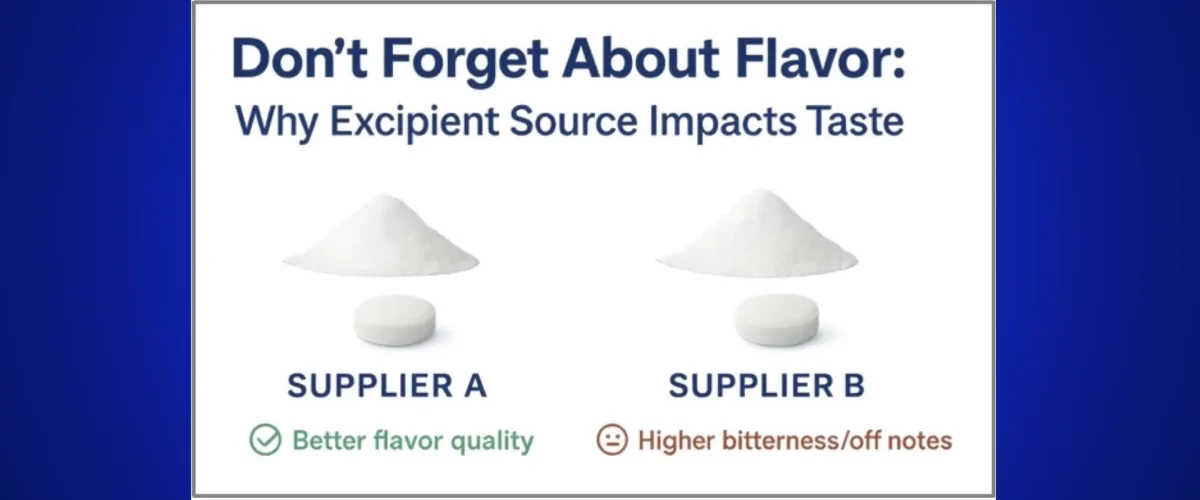
A question for formulation scientists: If we already dual-source for quality, supply, and cost—why are we not systematically dual-sourcing for flavor quality?


Explore expert perspectives, scientific advances, and practical strategies to help develop medicines that patients are willing to take.
Do you have an idea for a future topic? We’d like to hear from you at feedback@senopsys.com.
A question for formulation scientists: If we already dual-source for quality, supply, and cost—why are we not systematically dual-sourcing for flavor quality?

A neighbor slipped and fell in his driveway. He was unable to get up and was taken to the hospital by ambulance. Before medical treatment could be initiated, the hospital needed to run diagnostic tests, e.g., x-ray, MRI. The same is true for developing palatable formulations – it’s not enough to know that it tastes “yucky” as there’s no universal “yummy” excipient.

It is widely recognized that young children cannot swallow traditional tablets, but difficulty in swallowing tablets (dysphagia) is not limited to children. An estimated 40% of adults report difficulty in swallowing tablets, which is increasingly common among older patients. How can the formulation scientist address these important patient needs, and how can “swallowability” even be quantitatively measured?

An estimated 80% of new drug actives are classified as poorly soluble. There are a number of approaches for enhancing solubility – alternative salt forms, particle size reduction and solubility-enhancing excipients, among others. Like APIs, many excipients are known to be bitter or have other aversive sensory attributes including aromatic off-notes (malodor) and trigeminal irritation (e.g., tongue sting and mouth or throat burn). In some cases, the taste masking challenge of the excipient system can be greater than for the API itself.
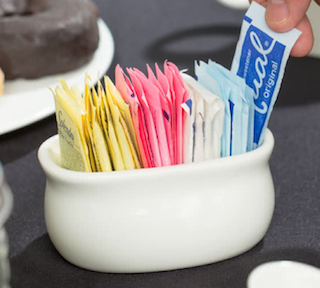
Try this experiment next time you are in a coffee shop: Open a packet of artificial sweetener (pink, yellow, or blue) and pour it directly on your tongue. Yuck! That tasted nothing like a spoonful of sugar – so what happened? Though artificial sweeteners are widely used in pharmaceuticals, formulating with them is far from straightforward.

If you’re a Disney fan of a certain age, you probably can sing the lyrics to Mary Poppins Spoonful of Sugar Makes the Medicine Go Down. Many APIs are known to be bitter, some extremely so. The addition of flavor – orange, grape, berry, chocolate – cannot reduce bitterness as taste and smell have different perception pathways. Rather bitterness is reduced by blending with the complementary basic tastes – sweet, sour and salty – through the mechanism of taste/taste interaction. When properly blended, the result is a neutral tasting (“white”) base in which the basic tastes are not separately perceived.

To a sensory scientist “flavor” refers to all tastes, aromas, mouthfeels and textures of a product. To a formulator, a flavor is a commercial ingredient that is a blend of volatile chemicals responsible for imparting the aroma of a product. In this post, we’ll focus on the formulator’s view, describing how these commercial “flavors” are created.

Recently, a strange noise from my car required a trip to the mechanic. Before the garage can start repairs, they need to diagnose the problem – is it a worn clutch or an exhaust? The same is true for developing palatable formulations – it’s not enough to know that it tastes “yucky” as there’s no universal “yummy” ingredient.

Sensory analysis is a scientific discipline used to evoke, measure, analyze, and interpret those responses to products that are perceived by the senses of sight, smell, touch, taste, and hearing. In our latest blog post we describe the methods most commonly employed to guide the development of palatable, taste-masked drug products.

By FDA regulation, flavor excipients are divided into four categories. What are the practical differences between these categories and which are appropriate for pharmaceutical formulations? In our latest post, we hope to answer these questions.